

Magic Carpet pilots
Stanley Epstein says he is not a religious man, but Operation Magic Carpet "had to have been blessed by God because the possibility of any of these airplanes being successful was pretty remote."
Epstein, a pilot and maintenance specialist, was airlifting supplies from Czechoslovakia to Israel. When that operation ended, he contracted with Alaska Airlines to help with Operation Magic Carpet. The humanitarian airlift operation brought more than 40,000 Yemenite Jews to Israel between late 1948 and early 1950.
"Their legend said they would be returned to Israel on the wings of an eagle. Alaska Airlines painted an eagle with outstretched wings over the door of each airplane and it reassured people when they got on the plane. They were living their legend and Alaska Airlines helped fulfill that legend," Epstein said in a phone interview from his home in Los Angeles.
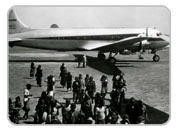
The threat was that Jewish refugees and maybe even crew members would be killed if they landed in Arab territory.
"There was an overpowering humanitarian need," Epstein said. "There was rioting in Yemen over the concentration of Jews. The British—who controlled Aden as a colony—were putting pressure on us to get the airplanes turned around and get the refugees out of there."
Maguire, an Alaska Airlines pilot with management experience, was sent to the Middle East near the end of 1948 by company President James Wooten to start-up Alaska's participation in Operation Magic Carpet.
"I had just come back from Asia where we had started a charter operation with the government to take civilians into Japan," Maguire said. "I had worked with Jim and had business experience that the other pilots didn't. The combination of business and flying experience was the reason I was asked to start Operation Magic Carpet."
Originally, the operation used only Alaska Airlines planes and crews. But because the demand was so great, additional pilots (such as Epstein) and planes were brought on.
"There were high death tolls in the refugee camps and they were having trouble with the Arabic population" Maguire said in a recent phone interview from his home in Ventura, California. "Moving that many people under those conditions required an operation that would have been illegal under U.S. aviation rules."
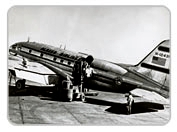
"People from our government came over and saw that this was an emergency situation and allowed us to set up an operation that would move the people," Maguire said.
“In addition, pilots flew much longer than would have been allowed in the U.S. Maintenance was difficult and planes flew well beyond their scheduled service intervals” Maguire said. "But remember, the environment was tense and time was of the essence."
"I was flying between 270 and 300 hours a month," Maguire said. "I wouldn't have been able to fly more than 90 hours a month back home and fuel was a big problem. Israel didn't have enough, we had to buy it from the British in Asmara. We would fill up there with enough to go pick up our passengers in Aden, fly them to Israel and then return."
While the operation was successful it took a toll on Maguire. "I lost my pilot's license a year and a half after I returned because of health reasons," he said. "The doctor was an old friend of mine, a flight surgeon. He told me that he couldn't let me fly anymore because of the health and safety issues. I had a heart condition and I didn't find out until later that there were parasites in the water where we swam in Aden that contributed to the problem.”
Epstein said the danger and logistical hurdles that had to be overcome were top of mind at every turn, but the plight of the Jews is what drove everyone to keep going forward. "For the English-speaking volunteers in Israel, the story of the Jews from Yemen was just another amazing story of the gathering of the Jewish people in their homeland. If there was a single reason felt by all of the English-speaking flight crews and other volunteers, it was a feeling of 'never again' after the press and other news media dramatically revealed the stories of the Holocaust."