

Alaska Airlines history
The Alaska Spirit is born

For 90 years, Alaska Airlines and the people who make us who we are, have been guided by integrity, caring, ingenuity, professionalism, and a unique spirit—a spirit that has grown out of our geographical roots.
Who we are today is a direct result of our history and the amazing people involved in it; a long list of aviation milestones, paired with countless stories of people being remarkable to help others.
All these milestones, good deeds, and community involvement have helped us grow us from a small regional airline to an international carrier. With more than 44+ million customers a year, our route system spans more than 120 destinations and five countries.
McGee Airways and Star Air Service
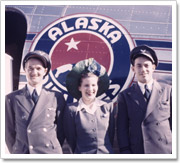
We trace our roots back to 1932, when two companies started flying in Anchorage: McGee Airways, and Star Air Service.
Early in the year, Harvey Barnhill and Linious “Mac” McGee founded Barnhill & McGee Airways. It became McGee Airways a few months later, solely owned and operated by Mac McGee.
At nearly the same time, Star Air Service was formed when mine owner Wesley "Earl" Dunkle loaned money to pilots Steve Mills, Charlie Ruttan, and Jack Waterworth. Initially just a flight school, Star Air Service commercial operations began in earnest in 1933. In 1935, Mac McGee sold his airline’s assets to Star Air Service, but would later return to manage Star Air Service twice.
After several more mergers, where many more carriers were woven into the fabric of the company, the Star Air Service name was changed a couple of times—until 1944, when they found one that stuck: Alaska Airlines, the name we use today.
By the late 1940s, using surplus military aircraft, Alaska Airlines had branched into worldwide charter work, including the Berlin Airlift in 1948 and Operation Magic Carpet, the airlift of thousands of Yemenite Jews to Israel in 1949.
In the late 1960s, we strengthened our operating base by merging with Alaska Coastal-Ellis and Cordova airlines, legendary Southeast Alaska carriers owned by aviation pioneers Shell Simmons, Bob Ellis, and Mudhole Smith. At Alaska Airlines, our world now stretched from Fairbanks south to Ketchikan and down to Seattle. Even during some of the coldest days of the Cold War, we made headlines with regular charters to the Soviet Union.
A new era
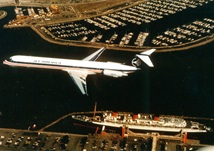
When Fairbanks businessmen Ron Cosgrave and Bruce Kennedy came on board in 1972, our airline was in a financial fight for its life. Those two men went to work setting goals and bringing people together. They won back the trust of creditors and improved on-time performance. One break that went their way was the construction of the trans-Alaska Pipeline; carrying supplies, equipment, and workers, gave our struggling airline a shot in the arm.
In the end, we decided to differentiate ourselves by offering outstanding customer service. This approach was so well received that it became the platform for us to grow our company with the unprecedented record of nineteen straight years of profitability.
In 1979, the airline industry was deregulated. For many carriers this was the end of the road. For us at Alaska, it was a new beginning. Our airline expanded methodically throughout the West Coast and in 1987 joined forces with two carriers similarly committed to outstanding customer service—Horizon Air and Jet America.
By the end of the 1980s, we had tripled in size. Our fleet had increased five-fold and our route map included scheduled service to Mexico and Russia.
Continuing the legacy
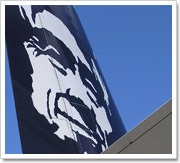
While growing into our business, and into our own identity over the years, we have continued to differentiate ourselves by offering the best customer service in the industry.
We have grown in leaps and bounds over the years. In 2001, we opened up the East Coast with our new service to Washington D.C. Since then we have established major footholds in the other cities on the East Coast and Midwest. More recently, we have headed further west flying across the Pacific with new service to Hawaii.
At Alaska, we also pioneered technologies and customer innovations that make the travel experience easier. We were the first airline in North America to sell tickets online and first in the world to allow customers to check in and print boarding passes via the Internet.
At Alaska, we have blazed trails in navigation technology too, allowing us to fly into fog-shrouded Juneau, Alaska, and airspace-restricted Washington, D.C., with equal precision.
In December 2016, Virgin America was acquired by Alaska Airlines to create the West Coast’s premier airline. The two airlines were granted a single operating certificate by the FAA in 2018 and now operate as a single airline under the Alaska brand.
Alaska is a member of the oneworld® global alliance. With the alliance and our additional airline partners, guests can travel to more than 1,000 destinations on more than 20 airlines while earning and redeeming miles on flights to locations around the world. Reducing our environmental impact to protect the beautiful places in which we live, and fly, is part of our DNA. We were the first airline to compost and remove single-use plastic straws and citrus picks from planes and our lounges, and have been champions of sustainable aviation biofuels since 2011.
Whenever the history of commercial aviation is written, people ask how an obscure little airline in America's hinterland has continued to survive and thrive while once-proud giants disappeared. Grit and determination will be part of the answer. However, more than that, it's our people. Their caring, their resourcefulness, their integrity, their professionalism, and their spirit. The unique spirit of The Great Land where our airline was born.