

Shell Simmons
At Alaska Airlines, our roots trace back to the Great Depression and the resourcefulness of Mac McGee. For Linious "Mac" McGee, 1932 marked the beginning of a new way of life, steady work.
Seeking opportunity during the Great Depression, he stowed away on an Alaska-bound steamship hoping to find better times. The Indiana native and transplanted Montanan went on to worked as a miner, truck driver, dishwasher, and fur buyer in turn. But it wasn't until 1932 that he found his calling when he launched an airline that would, after years of aviation pioneering, grow to become one of the largest airlines based in the US.
Along the way, he teamed with other aviation adventurers, such as Harvey Barnhill, Charlie Ruttan, Steve Mills, and Oscar Winchell (pictured here at McGee's right in 1959), to help revolutionize transportation in the Alaska Territory. By overcoming tremendous risks—frequent crashes, forced landings, terrible weather, unreliable airplanes, primitive navigation, and Alaska's vast and unforgiving terrain—Mac and his colleagues became vital parts of the state's history.
While his daring exploits made national headlines, Shell Simmons was an innovator and entrepreneur at heart. He made his living in the air, but is remembered by friends and colleagues as down to earth. He was famous for daring rescues and mercy missions, but was eulogized as someone who put no stock in heroism—he just did what he thought was right.
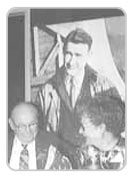
Shell Simmons (pictured at right circa 1980 at banquet honoring his early work) was a pioneer bush pilot of legendary renown. He founded one of the airlines that formed the Alaska Airlines of today.
"Shell often said he didn't want to be romanticized as a mercy pilot," Jim Johnson, Alaska Airlines senior vice president emeritus said at Simmons’ November 1994 funeral in Juneau. "To him, the daring missions were just another aspect of the profession."
Indeed. There was much more to Simmons than heroic acts. He was a skilled businessman whose high standards helped build a one-plane fleet into a major regional carrier. He was an innovator, improving seaplane designs and engine performance all while playing a key role in gaining approval for instrument landings in Sitka and night flights in Juneau. He was an excellent mechanic with a background in engineering that earned him the admiration of federal regulators for the reliability of his planes. You could tell that he was passionate about his work by his frequent use of colorful language.
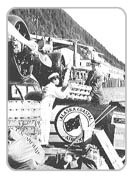
He made giant contributions to Alaska Airlines, the state of Alaska, and commercial aviation.
The most storied of Simmons' exploits was the 1938 rescue of the crew of the cargo ship Patterson that ran aground in the storm near Cape Fairweather, one of the most inaccessible beaches on the Alaska Coast. Navy planes and Coast Guard cutters couldn't get to the 18 survivors because of huge swells, a driving snow, and gale-force winds.
After two weeks, the situation getting desperate, Simmons acted on his own. "To our awe and amazement," said one of the stranded, Simmons landed his floatplane in the bubbling surf. He flew out two of the weakest sailors, and a trapper who Simmons brought along guided the others 15 miles down the coast where a boat could reach them. Simmons was lauded nationally. Always reluctant to be in the limelight, he dismissed his actions as "just work."
"To fully grasp just how unassuming Shell was, you need to know that when he made the Patterson rescue he was still recuperating from injuries sustained in a crash three months earlier," said Johnson, whose 42-year airline career began with Simmons' Alaska Coastal Airlines. "In that crash, Shell dove beneath the water repeatedly before eventually saving a trapped passenger." The memory of that incident, caused by a faulty fuel line, stayed with Simmons for the rest of his life in the form of scars on his hands and face.
Adventure, it seemed, was Simmons' middle name. At 16, he quit school to become a deckhand aboard a freighter bound for Asia. Over the next three years he'd drive a delivery truck in Ketchikan, study electrical engineering in Los Angeles, and work as an electrician in the Alaska-Juneau Mine.
He quit the mine so he and a friend could sail 2,100 miles down the Yukon River in a 14-foot rowboat. This led, indirectly, to his career in aviation. When they landed in the Arctic, he took a job on a runway construction project, where he got the flying bug watching Noel Wien and others land on the unfinished airstrip.
Simmons returned to his boyhood home in Washington's Yakima Valley in 1929 to take flying lessons. Afterward, he went back to his job at the mine but started working with friends to restore planes and hone his flying skills. He went to work for a Juneau airline in 1934 but his assigned plane was damaged in a storm a short time later, and the owners couldn't afford to rebuild it. They sold the wreck to Simmons for $1. He promptly rounded up local investors to finance the rebuild and a new airline. Alaska Air Transport was born.
Simmons worked tirelessly. He flew at night, dropped off mail and Christmas turkeys for miners and even hauled the Juneau marshal to a gun fight. In the summer, he'd fly 16 hours a day. He was the first commercial pilot to fly year-round in Southeast Alaska.
When cash flow was tight, he'd accept company stock from his backers in lieu of salary, prompting one writer to describe Simmons and his well-worn attire as "a picture of poverty in flight." However, business grew and he acquired more planes. In 1939, he and competitor Alex Holden of Marine Airways joined forces to create Alaska Coastal Airlines.
In 1962, Alaska Coastal merged with Ketchikan-based Ellis Airlines to form the largest scheduled airline exclusively operating amphibians. Five years later, they merged with Alaska Airlines, bringing Simmons and partners Bob Ellis and Ben Benecke to the Alaska Airlines board of directors. Simmons served on the board for 13 years and was named director emeritus in 1981.
Simmons, who died at age 86, was preceded in death by his wife, Bea, and their only child, son Shelby.